
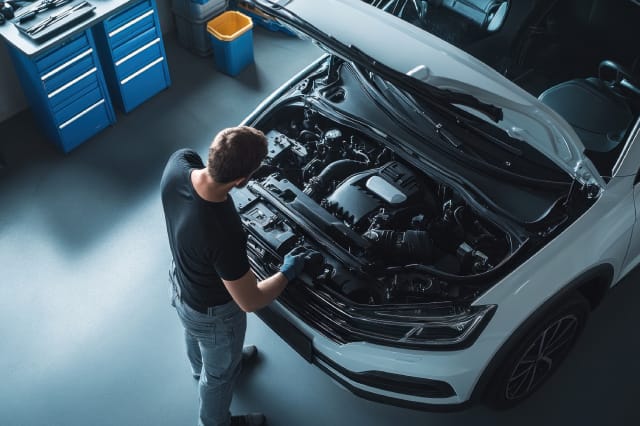
Luxury vehicle owners most commonly face issues with air suspension, advanced electronics, oil consumption, brake system wear, and cooling system maintenance; these problems are usually more complex and more costly than equivalent issues in standard vehicles. Staying ahead of them, rather than reacting, is what separates a well-maintained car from an expensive repair bill.
Fast Facts
- Air suspension components on vehicles like Range Rovers and Mercedes S-Class models can cost between $1,500 and $4,000 per corner to replace
- Many high-performance engines require oil changes every 5,000 to 8,000 km, not the 12,000 km intervals some owners assume
- Ontario’s freeze-thaw cycle is particularly hard on suspension bushings and control arms in lower-riding luxury vehicles
- Carbon buildup on direct-injection engines is a known issue across BMW, Audi, and Porsche platforms, and is often missed until performance drops noticeably
- Luxury vehicle brake systems, especially those with ceramic or compound rotors, typically require more frequent inspection than standard disc setups
Air Suspension: The Most Misunderstood System on the Car
Air suspension is one of the first things that gets brought up when luxury vehicle owners start talking about repair costs. And for good reason. Systems found on Range Rovers, Mercedes, Audi, and similar platforms are genuinely impressive when they’re working, but they’re also among the first things to develop problems as the vehicle ages. Compressors wear out. Air struts develop leaks. Ride height sensors drift out of calibration. In many cases, a failing component will be compensated for by the vehicle long before the driver notices anything, which means the problem is often further along than it appears when it finally surfaces. Interesting how that works.
Carbon Buildup on Direct-Injection Engines
This one catches a lot of owners off guard. Direct-injection engines, which are standard across most modern BMW, Audi, Porsche, and Mercedes platforms, spray fuel directly into the combustion chamber rather than through the intake valves. That’s efficient. But it also means the intake valves are never washed by fuel, so carbon deposits accumulate over time. Performance drops gradually, which makes it easy to miss; by the time it’s noticeable, a walnut blasting service or manual cleaning is usually required. Not a crisis, but something that should be part of a regular service conversation rather than a surprise.
Brake System Wear: Higher Standards, Higher Costs
Serious demands are placed on brake systems by luxury and performance vehicles. Larger rotors, higher clamping force, and in some cases ceramic or carbon-ceramic compounds, all designed to handle repeated hard stops. That sounds good on paper, but these systems are inspected less often than they should be, partly because they tend to feel fine right up until they don’t. Brake fluid is often overlooked entirely, even though moisture is absorbed by it over time and flushing should be done on a schedule. Rotors on performance vehicles can also warp or develop surface issues that standard brake checks don’t always catch. To be fair, it’s an easy thing to defer.
Cooling System Maintenance Gets Skipped More Than It Should
The cooling system on a high-performance engine is doing a lot of work. Thermostats, water pumps, coolant hoses, and the coolant itself all have service lives that tend to be underestimated. Over time, coolant degrades and becomes acidic, which causes corrosion inside the system. Water pumps on some German platforms are known to fail earlier than expected, particularly on higher-mileage vehicles. A cooling system failure on a performance engine isn’t just inconvenient; serious damage can be caused quickly. Anyway, that’s usually where it clicks for owners who’ve been putting off a full fluid service.
Electronics and Software: The Hidden Maintenance Layer
Modern luxury vehicles are as much software platforms as they are mechanical machines. And software, like any other system, requires attention. Module updates, sensor calibrations, and communication errors between control units are all part of the ownership picture now. Ontario owners who’ve had their vehicles serviced at shops without the right diagnostic equipment often find that problems come back, or get misdiagnosed entirely, because the root cause was never properly identified. The same tools and software access that the manufacturer uses are required for proper diagnostics. That’s not a small distinction. Hard to explain sometimes, but it matters.
Tire and Wheel Maintenance on Performance Fitments
Performance tires on luxury vehicles are often run at lower profiles and wider widths than standard tires. Handling is improved significantly by that setup, but it also means less sidewall to absorb impacts. Ontario roads, particularly in spring after a hard winter, are hard on low-profile tires and the wheels beneath them. Bent rims, cracked sidewalls, and accelerated wear from improper inflation are all common. Tire pressure monitoring systems on these vehicles are more sophisticated than standard setups, but calibration is still required after rotations or replacements. Wheel alignment also drifts more noticeably on performance suspensions, and it affects tire wear faster than most owners expect.
Oil Consumption and Engine Health
Some performance engines consume oil between changes. That’s not necessarily a defect; it’s a characteristic of how certain engines are built to run. But it does mean that oil levels need to be checked between service intervals more carefully than on a standard vehicle. Owners who go by the service reminder alone, without checking the dipstick, can find themselves running low without any warning light triggering. High-performance engines also tend to be more sensitive to oil quality. The correct viscosity and specification isn’t optional on these platforms, I suppose; it’s the difference between an engine that lasts and one that doesn’t.
Keeping It All Together: What Right Tech Offers Ontario Owners
Luxury vehicle ownership in Ontario comes with real maintenance demands, and the gap between a shop that understands these vehicles and one that doesn’t is significant. Right Tech Auto Repair and Service works with luxury and exotic vehicle owners across Ontario who want dealership-level expertise without the overhead, the attitude, or the inflated service estimates. The work is done right, the diagnostics are thorough, and the conversation is straight. If you’re looking for a shop that treats your vehicle the way you do, visit the Right Tech website to learn more and book your service.
Mini-FAQ
Q: Why do luxury cars seem to have more electrical problems than regular vehicles?
They carry significantly more onboard technology. More sensors, more modules, more software, and more potential failure points. That complexity is what makes them impressive to drive, but it also means a single faulty module can trigger a cascade of warning lights. Diagnosed properly, most of these issues are manageable. Diagnosed poorly, they get expensive fast.
Q: Do luxury vehicles really need more frequent oil changes?
Fair point to question, especially when the owner’s manual sometimes suggests longer intervals. But many high-performance engines run tighter tolerances and higher operating temperatures, which breaks down oil faster. In many cases, following the manufacturer’s maximum interval is fine for casual driving, but pushing it in a performance context tends to show up in engine wear over time. Not always immediately. Over time.
Q: Is air suspension worth repairing, or should owners consider converting to coilovers?
It depends on the car and how it’s used. Air suspension is engineered to deliver a specific ride quality, and on vehicles designed around it, a coilover conversion changes the character of the car noticeably. Repairs can be costly, but the system is usually worth maintaining if the vehicle is being kept long-term. Conversion makes more sense in specific performance or off-road contexts.
Q: How does Ontario’s climate affect luxury vehicle maintenance?
It affects almost every system. Road salt accelerates corrosion on brake lines, suspension components, and undercarriage hardware. The freeze-thaw cycle puts stress on air suspension, tires, and wheel bearings. And cold starts in winter are harder on engines that require premium synthetic oil to circulate properly. Vehicles that sit through Ontario winters without proper preparation tend to show it within a season or two.