
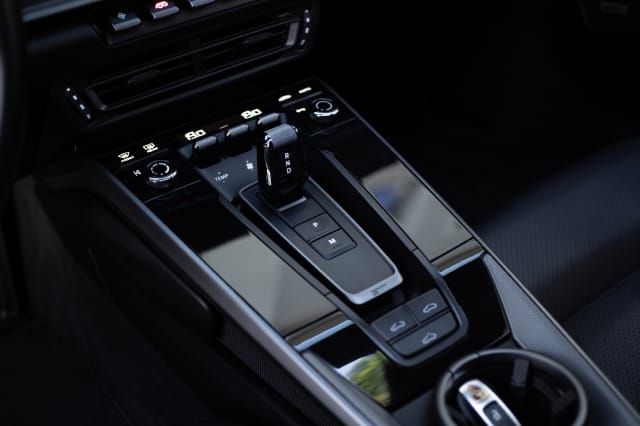
Transmission problems in high-performance vehicles usually show up as delayed or rough gear shifts, slipping between gears, unusual noises during acceleration, or fluid leaks under the car. In many cases, a warning light appears alongside these symptoms; but by then, some damage may already be underway. Getting it looked at early makes a real difference. Visit Website to book a diagnosis with Right Tech Auto Repair and Service.
Fast Facts
- Transmission fluid should generally be inspected every 50,000 to 80,000 km in high-performance vehicles, though shorter intervals are recommended by some manufacturers under aggressive driving conditions.
- Slipping gears, where engagement is unexpectedly lost or changed by the transmission, is one of the most reported early warning signs in performance cars.
- Delayed engagement, that pause between shifting into Drive or Reverse and the car actually moving, can signal internal wear or low fluid pressure.
- In Ontario, temperature extremes, from deep winter cold to summer highway heat, can accelerate transmission wear in vehicles not properly serviced for local conditions.
- A burning smell from the transmission area is often caused by overheated or degraded fluid, not a minor issue.
Why High-Performance Transmissions Deserve Extra Attention
High-performance vehicles put their transmissions through considerably more stress than a standard commuter car. Higher torque outputs, faster shift cycles, and more aggressive driving patterns all add up over time. The components involved, whether it’s a dual-clutch, automated manual, or traditional automatic, are engineered to handle that load, but they’re not immune to wear. In many cases, the very things that make these vehicles exciting to drive are also what make their transmissions more sensitive to neglect or delayed maintenance. That tension is worth keeping in mind, bit by bit, every time service intervals get pushed.
Delayed Engagement: The Pause That Shouldn’t Be There
Shift into Drive, and the car should move. Simple as that. When a noticeable pause appears, a moment where the engine is running but nothing seems to be happening, that condition is called delayed engagement. It’s often one of the first signs that something’s off internally. Low fluid pressure, worn clutch packs, or early valve body issues are usually what cause the delay. It might only last a second or two, but that hesitation tends to get longer over time if it’s left unaddressed. Worth noting early, I suppose.
Gear Slipping and What It’s Actually Telling You
Slipping gears are hard to ignore once they start. The engine revs climb, but the car doesn’t accelerate the way it should, and the transmission seems to be searching for a gear, or briefly losing its hold on one. In high-performance vehicles, this is often tied to worn clutch components or degraded fluid that’s lost its ability to maintain proper hydraulic pressure. From what we’ve seen, owners sometimes chalk this up to “the car being in a mood,” especially with older exotics; that sounds reasonable on paper, but it’s not that. It’s a mechanical signal, and it tends to get louder over time.
Unusual Noises During Shifts or Acceleration
Clunking, whining, or humming sounds that appear during gear changes or under acceleration are worth taking seriously. A healthy transmission in a performance car is generally quiet, or at least consistent in its sound. New noises, especially ones that change with speed or load, are often being produced by worn bearings, damaged gears, or low fluid. Whining that gets louder as speed increases is a common one; so is a clunk when shifting from Park into Drive. Neither is normal. Neither should be ignored.
Fluid Leaks and What the Colour Tells You
Transmission fluid leaks can be identified by their location and colour. Fresh fluid tends to be red or pink and slightly sweet-smelling, while older, degraded fluid is darker, sometimes brown, and carries a burnt quality to it. A leak spotted under the centre or rear of the vehicle is often transmission-related. In Ontario, where significant seasonal temperature swings are experienced by most vehicles, seals and gaskets can degrade faster than expected, particularly in cars that sit for extended periods in cold weather. Finding a small stain early, to be fair, is far better than finding a large one later.
Shuddering or Vibration During Acceleration
A shudder during acceleration, particularly at lower speeds or when the transmission is shifting between gears, can point to a few different issues. Torque converter problems are a common cause in automatic transmissions; worn clutch components in dual-clutch setups are another. The shudder is often most noticeable between 40 and 80 km/h, which happens to be a common speed range on Ontario roads during city driving or highway on-ramps. It’s not always dramatic. Sometimes it’s just a subtle vibration that feels slightly off, but it tends to get more pronounced as the underlying issue develops. Anyway, that’s usually where it clicks for most owners that something needs attention.
Warning Lights and What They Don’t Always Catch
The transmission warning light, or in some cases a general check engine light triggered by a transmission-related code, is a useful signal, but it’s not a complete picture. Specific parameters are monitored by sensors, and those sensors aren’t always positioned to catch early mechanical wear before it escalates. A car can be developing a real transmission problem and show no warning lights at all, at least for a while. That’s why paying attention to how the vehicle feels and sounds matters just as much as watching the dashboard. Both sources of information, sometimes, are worth taking seriously.
Getting It Checked at Right Tech Auto Repair and Service
If any of these signs sound familiar, the right move is a proper diagnosis from someone who actually knows performance and luxury vehicles. Right Tech Auto Repair and Service works with exactly these kinds of cars across Ontario, providing the kind of thorough, honest assessment that owners of high-end vehicles deserve. No upselling, no vague explanations, just a clear read on what’s happening and what it takes to fix it properly. Visit Website to learn more or to get your vehicle booked in before a manageable issue becomes something much more expensive.
Mini-FAQ
Q: Can a high-performance car’s transmission fail without any warning lights coming on?
Absolutely, yes. Warning lights are triggered by sensors, and sensors don’t always catch early mechanical wear before it becomes a bigger problem. A lot of transmission issues, especially early-stage ones, are felt before they’re flagged electronically.
Q: Is it normal for a sports car or exotic to shift a bit roughly?
Because some performance vehicles do have firmer, more aggressive shift characteristics by design. But there’s a difference between a purposeful, sporty shift and one that feels hesitant, clunky, or inconsistent. If the feel has changed from what you’re used to, that’s worth paying attention to. Changes in shift quality are often how transmission problems first make themselves known.
Q: What does transmission slipping actually feel like in a high-performance vehicle?
It’s usually described as the engine revving higher than expected without a corresponding increase in speed. Like the power is there, but it’s not connecting properly. In some cases, the car may briefly feel like it’s in neutral mid-drive. Not a subtle sensation once it starts happening regularly.
Q: How urgent is a transmission fluid leak in a luxury or exotic car?
It depends on the severity, but a leak should never be left alone. Transmission fluid is what keeps internal components lubricated and cool, and running low on it, even briefly, can cause significant damage in a high-performance drivetrain. A small stain on your driveway is worth investigating sooner rather than later.