
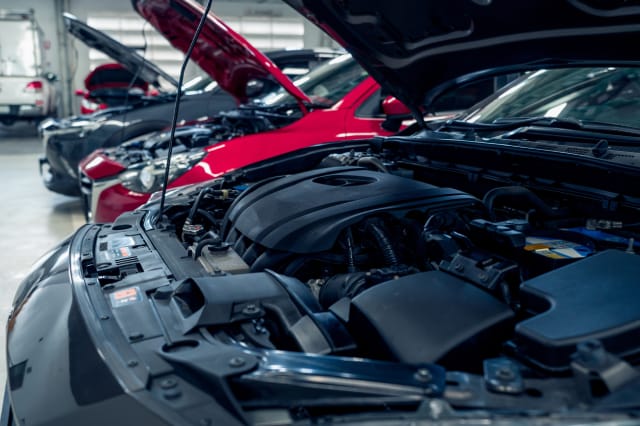
OEM parts are usually worth the additional cost for luxury vehicles when the repair involves safety-critical systems, complex electronics, or components with tight factory tolerances; for more general wear items, quality aftermarket alternatives can perform comparably. The right choice depends on the part, the vehicle, and who’s doing the work. Right Tech Auto Repair and Service can help you sort that out.
Fast Facts
- OEM stands for Original Equipment Manufacturer, meaning the part is made to the exact spec the vehicle left the factory with
- On vehicles like BMW, Mercedes-Benz, Porsche, and Land Rover, some electronic modules will only calibrate correctly with OEM components
- Aftermarket parts vary widely in quality; a reputable brand can match OEM performance, while a budget option may not last half as long
- In Ontario, using non-OEM parts does not void a vehicle warranty under the Competition Act, but documentation matters
- For high-wear items like brake pads, filters, and wiper blades, quality aftermarket parts are often a practical and cost-effective choice
What OEM Actually Means, and Why It Gets Complicated
OEM means the part was made by, or to the exact specification of, the original manufacturer. So an OEM brake rotor for a Porsche 911 is the same component, or a direct equivalent, to what was fitted at the factory in Stuttgart. That sounds straightforward. But the category gets complicated quickly, because some parts branded as OEM are actually manufactured by third-party suppliers under contract, while certain aftermarket parts come from those same suppliers. The label doesn’t always tell the whole story; what matters more is whether the part meets the engineering spec for that specific vehicle. Worth keeping in mind, I suppose, before the label alone drives the decision.
Where OEM Parts Genuinely Earn Their Price
Some systems on luxury and exotic vehicles are calibrated to work within very specific tolerances. Adaptive suspension components, electronic stability modules, and advanced driver assistance hardware are good examples. These aren’t parts where “close enough” is acceptable, and that distinction matters more than it might seem. If a replacement component doesn’t communicate correctly with the vehicle’s control systems, the result can range from a warning light that won’t clear to a system that simply doesn’t function as designed. In those cases, OEM isn’t just a preference. It’s the practical call. From what we’ve seen at Right Tech, this comes up most often on European marques with complex chassis electronics.
Where Aftermarket Parts Are a Perfectly Reasonable Call
Not every repair on a luxury vehicle requires an OEM component. Wear items, in particular, are often well-served by quality aftermarket alternatives. Brake pads, air filters, cabin filters, belts, and wiper blades are produced by many reputable suppliers who meet or exceed OEM standards, and some of those suppliers, oddly enough, also produce the OEM-branded version sold through dealerships. That sounds good on paper, but the key word here is quality. A recognized brand with a track record in the category is a different proposition than an unknown budget option pulled from a parts bin. Price alone isn’t the right filter. To be fair, it never really was.
The Warranty Question Ontario Drivers Often Get Wrong
There’s a common concern among luxury car owners across Ontario that using non-OEM parts will void their vehicle’s warranty. In most cases, that’s not accurate. Consumers are generally protected under Canadian competition law from warranty voidance simply because a non-OEM part was used, as long as the part itself wasn’t defective and didn’t cause the failure in question. That said, the protection works better when the repair has been documented properly, including who did the work, what part was used, and what condition the vehicle was in before and after. Gaps in that record can create complications that good documentation would have prevented.
A Scenario That Comes Up More Than You’d Think
A client brought in a late-model Range Rover Sport after a suspension repair had been done elsewhere. An aftermarket air suspension compressor had been used by the previous shop, which sounded like a reasonable decision on paper. But the replacement unit hadn’t been calibrated to the vehicle’s ride height management system, and within a few months faults were being logged and the ride was becoming inconsistent. When the OEM compressor was installed, the issue was resolved. The cost difference between the two parts was real, but the cost of the second repair was higher. Anyway, that’s usually where it clicks for people; the savings on the part can disappear quickly if the part doesn’t perform. Funny thing, really.
How to Think About the Decision Before Authorizing a Repair
The most useful question isn’t “OEM or aftermarket?” in the abstract. It’s more specific than that. What system is being repaired? How safety-critical is it? What’s the vehicle’s age and mileage, and is this a component where tolerances are tight, or a general wear item with established aftermarket alternatives? A shop that knows luxury vehicles well should be walking through that reasoning with you before the work begins. The answer will probably be different for a differential seal than it is for a front control arm bushing, even though both are valid repairs. They just don’t carry the same risk profile.
What Right Tech Recommends, and Why
At Right Tech Auto Repair and Service, the approach is straightforward. OEM is recommended when the repair involves safety systems, complex electronics, or components where fit and calibration are critical. Quality aftermarket parts are recommended when the application supports it and the supplier has a demonstrated track record. The goal is never to push a more expensive part. It’s to give the vehicle what it actually needs, over time, without cutting corners that come back around. Luxury car owners in Ontario deserve that kind of honest assessment, not a default answer driven by margin. To learn more about how Right Tech approaches parts decisions for your specific vehicle, visit the website.
Mini-FAQ
Q: Does using aftermarket parts void my luxury car’s warranty in Ontario?
Generally, no. Under Canadian competition law, a manufacturer can’t void your warranty simply because a non-OEM part was used, provided the part wasn’t defective and didn’t cause the issue in question. That said, documentation is important. Records should be kept of what was installed and by whom. Worth knowing before you assume either way.
Q: What types of repairs genuinely require OEM parts?
Look, there are certain systems where OEM really does matter. Suspension geometry components, adaptive damping modules, transmission control units, and anything tied to driver assistance or safety systems tend to be engineered to tolerances that aftermarket suppliers don’t always match. A misfit part in those areas isn’t just a performance issue. It can be a safety one. That still surprises people.
Q: Are OEM parts always more reliable than aftermarket?
Fair point to raise. Not always. Some aftermarket manufacturers actually supply parts to the OEM brands themselves, so the component in a different box may be identical. The issue is consistency. Quality varies significantly across aftermarket suppliers, and without knowing the sourcing, it’s harder to predict how a part will perform over time. Reputable shops know which aftermarket lines hold up.
Q: Why do dealerships charge so much more for OEM parts?
Partly markup, partly overhead. Significant operational costs are carried by dealerships, and parts pricing reflects that. The parts themselves aren’t always priced differently at the source. What changes is the margin applied. Independent shops with strong supplier relationships can often source the same OEM components at a lower total cost to the customer. Not always, but often enough to ask.